Socializing a Havanese With Kids, Dogs and Strangers
General training information. Every dog is an individual; for health or behavior concerns, see your veterinarian.
Havanese socialization is about teaching your dog that the world is predictable and safe. The goal is a dog who stays calm around children, other dogs and visitors. It is not a dog who tolerates everything.
The United Kennel Club describes the breed as friendly, playful, alert and intelligent. It also says Havanese are quiet and gentle but enjoy rowdy play. That is a good starting point, but individual dogs vary. Your dog's own history and personality matter more than any breed description.
Are Havaneses Good With Kids and Other Dogs?
Many people ask whether Havaneses are good with kids. I cannot give you a breed-wide answer, and I would be wary of anyone who does. The sources I rely on do not give a firm rating for how the breed does with children or with other dogs. For that, talk with the Havanese Club of America or with the breeder of your dog. Ask about the temperaments of the parents and how the puppies were raised.
The same goes for how a Havanese gets along with other dogs. Treat it as something you build, not something you assume.
What the sources do say is useful. Westminster Kennel Club rates the breed 4 out of 5 for trainability and 4 out of 5 for barking. Purina notes that the breed does not like to be left alone and can be chatty and vocal. So expect a dog who wants to be with you, learns quickly, and may announce visitors loudly. That shapes how you plan socialization.
None of the sources I used flag guarding or herding behavior around children. If you see your dog stiffen, freeze, growl or snap near a child or a toy, treat it seriously. Give the dog space and talk to your veterinarian or a reward-based trainer.
What You Need
- Small, soft treats your dog loves, cut into pea-sized bits
- A well-fitted harness and a standard leash, about 6 feet long
- A baby gate or exercise pen to create a safe retreat space
- A mat or bed your dog can settle on
- A few friendly, calm adults who agree to follow your rules
- At least one calm, vaccinated, dog-friendly adult dog as a practice partner
- A notebook to track what went well and what did not
You also need your veterinarian's guidance on when your puppy can safely meet other dogs and visit public places. I do not have a firm age or schedule for you. Vaccination timing depends on your dog and your area, so ask your vet.
Step-by-Step Havanese Socialization Plan
Step 1: Build a Calm Foundation at Home
Before you introduce anyone, teach your dog two things: to look at you, and to settle on a mat. Say your dog's name, and when they look, give a treat. Then reward your dog for lying on the mat for a few seconds at a time, and slowly build up.
These skills give you something to ask for in every later step. If you are starting from scratch, our complete Havanese training guide covers the basics. Vetstreet notes the breed is easy to train and that you should start the day the puppy comes home.
Step 2: Pair New Things With Good Things
Socialization works through association. Each time your dog sees something new, such as a hat, a stroller, a delivery person or a bicycle, a treat appears. Keep your dog far enough away that they can still eat and stay relaxed. If your dog refuses food, you are too close, so add distance.
Keep sessions short. A few minutes is plenty. End while your dog is still happy.
Step 3: Introduce Strangers on Your Dog's Terms
Many Havanese are alert, and Westminster rates the breed 4 out of 5 for barking. Strangers at the door can be a big trigger.
- Ask the visitor to ignore your dog at first. No eye contact, no reaching.
- Have your dog on leash, sitting or on the mat, getting treats from you.
- Let your dog choose to approach. If they do, the visitor can offer a treat from a flat, low hand.
- If your dog hangs back, let them. Never push a dog toward a person.
- Keep the first meetings brief and end on a good note.
Repeat with different people over several weeks. Vary age, clothing, voices and settings, as long as your dog stays comfortable.
Step 4: Set Up Safe Time With Children
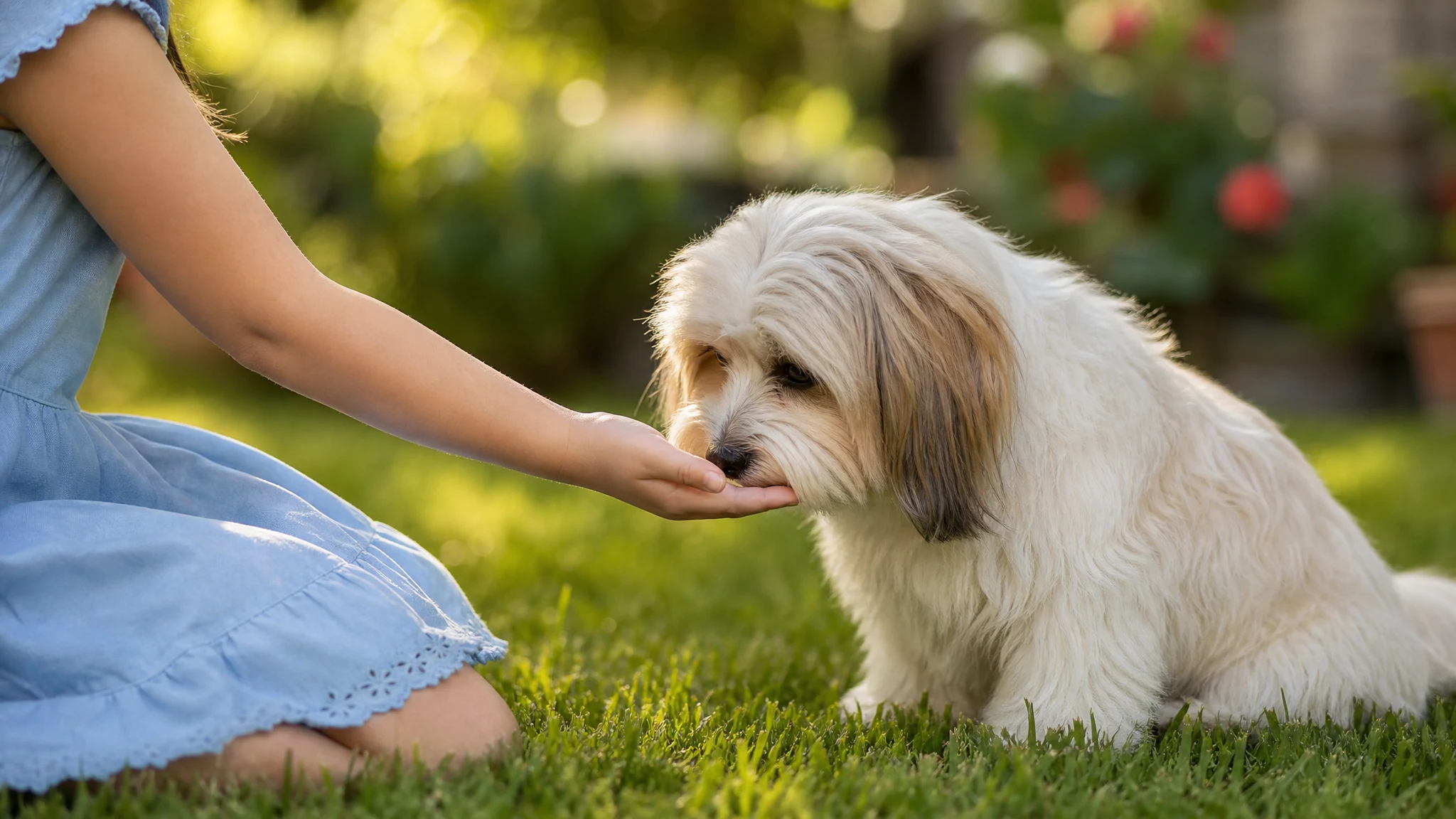
Whether Havaneses are good with kids depends a lot on the rules you set for the kids and the adult in charge. A small dog can be hurt by a rough hug, and a stressed dog may snap. Plan for both.
- Always supervise. An adult is actively watching, not just in the room.
- Teach gentle touch. Show children to pet the chest or shoulder with one calm hand, not to grab, hug tightly or lift the dog.
- Keep the dog low and safe. Young children should sit on the floor to interact. They should not carry a small dog around.
- Let the dog leave. Give your dog a gated area or bed that children must not enter. Respect it.
- Let kids join the fun. Children can toss a treat onto the mat or practice a simple cue, with an adult guiding.
Watch for stress signs: yawning, lip licking, turning away, showing the whites of the eyes, tucked tail or freezing. If you see them, calmly end the session and give your dog space.
Step 5: Introduce Other Dogs Slowly
Havanese with other dogs can do well, but the sources I use do not give a rating, so go step by step and let your dog's behavior guide you. Check with your vet first about vaccines.
- Start at a distance. Walk two calm dogs parallel to each other, far enough apart that both stay relaxed. Reward calm behavior.
- Close the gap over several walks. Move a little closer each time, only if both dogs look loose and wiggly.
- Allow a brief greeting. Keep leashes loose and let the dogs sniff for a few seconds. Then call them away and reward.
- Move to a fenced, neutral space. Drop the leashes only if both owners agree and both dogs are comfortable.
- Stop early. Break up play before it gets too wild. Short, happy meetings build trust.
The UKC says the breed enjoys rowdy play, so watch for play that gets one-sided. A good sign is both dogs taking turns chasing and pausing. If one dog keeps hiding or is being pinned, step in and give a break.
Step 6: Practice in Different Places
Once your dog is comfortable at home and in quiet spots, add variety. Try a bench outside a shop, a quiet sidewalk, or a friend's yard. Change one thing at a time. Keep a distance from crowds until your dog shows they can handle it.
Step 7: Teach Your Dog to Be Alone Too
Purina notes the breed does not like to be left alone. A dog who is always glued to you may struggle when people leave. Practice short, calm separations with a chew or mat, and build up gradually. Never use this as punishment.
If you see signs of real distress, such as nonstop barking, panting or destruction when alone, ask your veterinarian or a reward-based trainer for help.
Tips for Success
- Keep treats small and high value.
- Go at your dog's pace. Slower is usually better.
- Quality beats quantity. Three calm meetings help more than one overwhelming day.
- Use a harness and a loose leash so your dog never feels choked or pulled.
- Ask for calm behavior before greetings, such as a sit.
- Reward quiet. When your dog notices a noise and stays calm, mark and treat.
- Keep notes so you can spot patterns, such as a certain type of dog or a time of day that is harder.
Common Mistakes to Avoid
- Flooding. Dropping a shy dog into a busy event can make fear worse.
- Forcing greetings. Letting every stranger pick up or pet your dog teaches the dog that their opinion does not count.
- Scolding barking or growling. A growl is a warning. If you punish it, the dog may skip the warning next time. Instead, increase distance and get help.
- Using harsh tools or methods. The American Veterinary Society of Animal Behavior supports reward-based training. Shock, prong and choke collars, scruffing and alpha rolls can damage trust and raise fear and aggression.
- Leaving kids and dog alone. Even a friendly dog needs an adult watching.
- Assuming small means easy. A small dog can still be anxious, reactive or overwhelmed.
- Skipping health checks. Pain from problems like patellar luxation or hip dysplasia, which the Havanese Club of America lists among the breed's concerns, can make a dog grumpy or touchy. If your dog's behavior changes suddenly, see your vet.
What Results to Expect
With patient, regular practice, many Havanese become more relaxed with visitors, children and other dogs over time. Progress is rarely a straight line. You may see good weeks and rough weeks.
Over weeks to months, you may notice your dog recovering faster after a surprise, barking less at visitors, and looking to you for guidance. Some dogs will stay shy or choosy, and that is okay. The aim is a dog who feels safe, not one who loves everybody.
If you see growling, snapping, intense fear or aggression, stop the exercises that trigger it. Call your veterinarian to rule out pain or illness, then ask for help from a trainer who uses reward-based methods. No plan works for every dog, and results will differ.